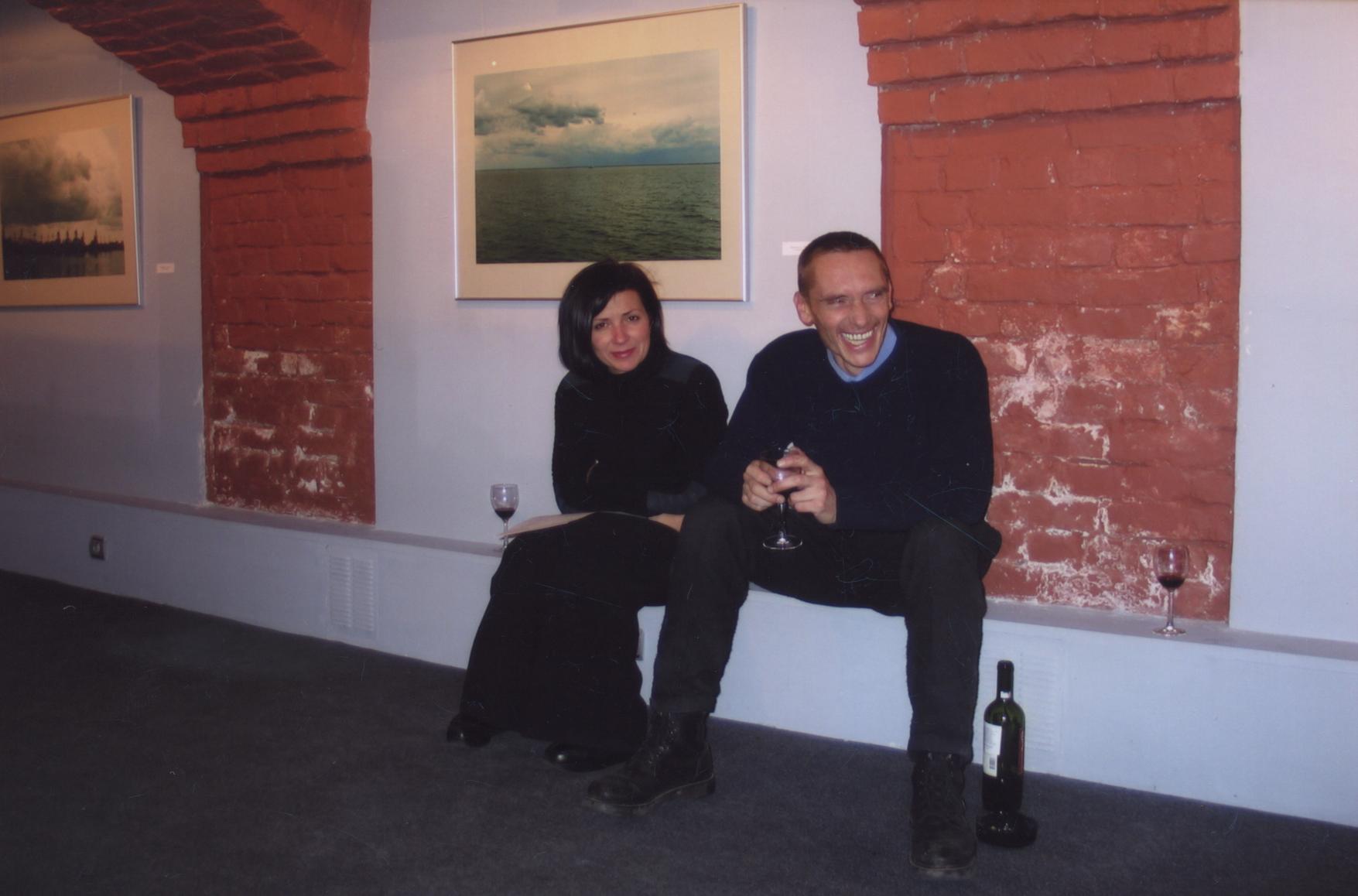
 The Lonely Hearts Club D137
Everyone has their own Georgy…
I would compare Guryanov to a planet around which a great number of different people-satellites revolved, whose orbits sometimes moved farther away and sometimes came closer to the center of attraction — according to his will. Sometimes the orbits coincided and the satellites revolved around Georgy together. Sometimes the orbits intersected, the satellites collided, and an explosion occurred in relationships — because everyone believed that his orbit was more important than the others. I observed this for thirteen years, during which the satellite of Gallery D137 gently floated around the planet named Georgy Guryanov.
Timur Novikov suggested that I meet Georgy in 1999 in order to organize his solo exhibition at Gallery D137, which at that time was moving from its namesake houseboat on Krestovsky Island to Nevsky Prospect. We went to Guryanov’s studio on Sadovaya Street as a group of three — myself, Timur, and Sergey Sergeev. Sergey had known Georgy since 1984; he was my friend and one of the inspirations behind the creation of the gallery.
I was very nervous, as I was a great admirer of the band Kino, and Timur had warned me that Georgy had a difficult character and, if he did not like something, he could simply throw a person out. Therefore, he said, one had to behave very carefully. When we arrived, Georgy was rather tense. We mostly talked about music. I mentioned my favorites — David Bowie and the band Talking Heads — to which he contemptuously threw out: “Bard song.” I thought: “My God, I am talking in vain,” and decided to remain silent.
When we were already about to leave, Timur steered the conversation toward the subject of an exhibition and casually remarked that Olga had recently opened a gallery. Georgy fiercely replied that he hated two professions more than anything in the world: gallery owners and psychologists. My second higher education happened to be in psychology… I was in despair.
Later, Sergeev told me that when he and Georgy went out to smoke on the balcony, Georgy asked:
“I would like an exhibition, but can we not rush? I need to repaint all the paintings — they are not yet perfect.”
After some time, we visited Guryanov’s studio again and began communicating more often. Gradually everything settled, and we became friends. I think Georgy appreciated my delicacy, my, as he called it, “Petersburg style.” We both loved Saint Petersburg; we were born there — moreover, in the same year. We liked talking about the city’s architecture and history. Our musical preferences also coincided. Later Georgy admitted that he loved both David Bowie and Talking Heads, but he had simply wanted to frighten me a little at our first meeting. We were united by aesthetic tastes. He liked my manner of communication because he could not stand rudeness. Often gallery owners are pushy and business-like, but he appreciated my diplomacy and the fact that I had opened the gallery as a patron and collector.
In the end, Georgy agreed to a solo exhibition titled:
“Georgy Guryanov (painting, photography, graphics)”, curated by Timur Petrovich Novikov. In September 2001 it took place and was a tremendous success, which was very important for a young gallery.
The face of the exhibition became the famous painting Gay Games Amsterdam, depicting rowers in a boat — among them one could immediately find several self-portraits of the artist. The author explained:
“If I could, I would paint only myself!”
One of the admirers of the band Kino asked Georgy at the opening why he played the drums standing up, whereas most drummers do so sitting down. Georgy, with the charm and self-irony characteristic of him, replied:
“So that I can be seen better. I am very handsome.”
He truly was handsome and valued his appearance greatly. Georgy possessed narcissism, but in the best, subtle sense: as a person aware of his uniqueness and the power of his image. Once he told me that at school, when classmates teased him for his freckles, he thought:
“I am a spotted, proud leopard.”
The following year, Gallery D137 participated in international art fairs — Art Moscow 2002 and Art Forum Berlin 2002.
The Berlin fair deserves a separate story. It was precisely there that the history of the rapid rise in prices for Guryanov’s works began. We brought works by Georgy Guryanov and Sergey Sergeev, whose metal objects looked excellent next to Georgy’s paintings. We perfectly understood that we could hardly count on sales. On the one hand, 2002 was economically difficult for Germany — the transition to the euro and severe flooding had weakened purchasing power. On the other hand, for Gallery D137 this was the first foreign fair, and we did not yet have strong connections in the international art environment or among collectors.
Seeing how highly the paintings were priced on neighboring stands, we made an unexpected decision: to exhibit our paintings at European prices and at least look достойно — respectable. And to our surprise, it worked. During the fair itself not a single sale was made, but our stand looked impressive — it attracted attention and appeared on the front pages of the press. Sales began later — but already at the new prices.
We had a wonderful time in Berlin, which Georgy adored. He would come to the stand at closing time; we would pour him a large glass of red wine because, as he said, he was “falling apart” after nightclubs and parties. Then we would go to dinner at Paris Bar, after which he would return to the city’s turbulent nightlife.
The idea for Georgy’s second solo exhibition was born in his studio. We were sitting in a small circle; he was showing photographs from a photo session of the band Kino on a sailing ship — all dressed in naval uniforms. Thus “Sailors and Skies” was born, an exhibition we held in March 2004. The curator was Andrey Khlobystin. Working with Georgy on the exhibition was an enormous joy. We listened to music, drank wine, talked about art, and rearranged the display until complete harmony was achieved.
Each exhibition at D137 was accompanied by music selected by the artist, continuously playing in the halls during the show. For “Sailors and Skies,” it was, of course, the band Kino. The atmosphere was a true celebration — it was one of the best exhibitions in the gallery’s history.
At Georgy’s request, I sent the paintings that remained after the exhibition to Paris, to Ilona Orel’s gallery. He dreamed of having an exhibition in Paris and also wanted to visit the château where Ilona lived with her husband. Georgy loved chic, beautiful life, loved beautiful women and men, parties in the spirit of The Great Gatsby. It was impossible to refuse him this. A rare gallerist would have acted this way, but we had friendly relations, and Georgy never had a contract with Gallery D137.
This never interfered with my work as a gallerist: Georgy and I always managed to find common ground, and he trusted me. We organized several of his solo exhibitions, including one at the XL Gallery in Moscow. Georgy’s works were regularly presented on D137 stands at various contemporary art fairs.
We also managed to arrange numerous interviews — which, I must admit, was not easy. Georgy could suddenly close up and not say a word, even if a film crew or an invited journalist with a photographer was already waiting for him.
Georgy could arrive very late to the opening of his own exhibition — or not come at all, if it seemed to him that “something was going wrong.” In such moments, I had to call, persuade, convince him.
Once he appeared at the opening of Sergei Pakhomov’s exhibition titled: “Are We Already Dead, or Is Pizdyulkin Listening.” For Pakhom, it was his first exhibition after a long break, and in addition to the show he gave a concert presenting his new album “Boncha.” At that time Georgy had a broken arm — he wore a plaster cast and did not feel well. We ran into each other at the entrance to the gallery — and at that very moment, from the hall, Pakhom’s ominous voice rang out: “And little Aliska — with an axe???”
Georgy froze.
I thought: “He’ll leave. Not his cup of tea,” as he himself liked to say.
But to my surprise, he stayed. He listened to the concert with obvious interest, and afterward spoke with pleasure with Pakhom about music.
Georgy had a very difficult character, but working with him was a true pleasure, despite certain problems which, of course, did occur. Once, during a trip to the Art Moscow fair, when all of Georgy’s paintings were already reserved and packed for shipment, he suddenly erased the face of one sailor in the morning because “he was not beautiful enough.” Or another case: once an agitated collector ran into the gallery and asked to contact Guryanov, because Georgy would not let him cross his threshold, even though he was ready to buy a painting. It turned out that Georgy considered this man rude and refused the sale, although at that moment he greatly needed money. There are many such stories.
I saw Georgy repaint sold paintings as they were being carried out of the studio because, in his opinion, they were not perfect.
For this very reason, during his lifetime I was unable to produce a catalogue of his works. The author demanded that before their images were printed, the paintings should be collected from the collectors and redone, and only then should the catalogue be made…
In Georgy Guryanov’s creative work, subjects are often repeated. I know about ten “Aviators” by him, and there are even two very similar works because he made a copy at my request. He also created many versions of “Rowers,” “Dives,” “Sailors,” and so on. However, these are different works. Georgy was interested in a certain image; he would take a drawing and depict it on several canvases, but he would make, for example, different clouds, different facial expressions, although the image remained the same. That was how he worked; that was what interested him. Georgy was constantly trying to achieve perfection. He would paint a picture, it would fly off to some collector, he would be dissatisfied with the result and would try from scratch to create an even better work. He did not repeat himself — he was searching for the ideal!
In ten years of working with the gallery, Guryanov became one of the most expensive Russian artists. But money was still not enough for him — he loved luxury, needed medical treatment, and lived on a grand scale when he managed to sell something.
“How I would like to cross the threshold of poverty,” he once said, opening a luxurious bottle of Château Margaux Premier Grand Cru Classé in his studio on Liteiny Avenue on his birthday, February 27.
Georgy received offers to work abroad, but once he told me that although he liked to travel, he loved Saint Petersburg very much and could not imagine himself anywhere else. Moreover, the early 2000s in the city were astonishingly lively: exhibitions, parties, concerts. Everything was blossoming, and it seemed that the future would only be better…
I vividly remember how in 2005, at the Art Moscow fair, we were drinking champagne at Aidan Salakhova’s gallery stand, celebrating excellent sales; foreign and domestic collectors were passing by; everyone was cheerful and satisfied. Aidan said:
“Can you imagine how wonderful everything will be in 2021!”
We were full of plans and hopes.
There are many stories I could tell, but I would like to share several episodes from that life when we not only worked a lot and passionately, but also knew how to rest magnificently. These moments vividly reveal Georgy’s personality, his character, and his charm.
At that time I had a magnificent Excalibur Mercury Tiffany automobile, in which we drove with artists to all sorts of events. The driver was a very calm and dignified man who treated the bohemian public with respect and always offered to make themselves comfortable in the cabin by manually pumping up the seats with a special rubber bulb. Once we went in the Excalibur with Georgy and Marina Albi to the “69” club. Georgy loved to appear in society beautifully. At the club I met Marc Almond, who kissed my hand when we were introduced. I enthusiastically told Georgy about it while he was standing at the bar. He asked which hand exactly, and kissed the other one. It was so simple and elegant, so touching and unforgettable!
There was another wonderful trip with Georgy in that car — to the Mariinsky Theatre for the ballet “Le Corsaire.” Georgy had two tickets in the stalls and offered me to accompany him. After picking him up on Liteiny Avenue, the driver and I waited about forty minutes. Georgy called me with apologies and said he needed five more minutes to put himself in order. Of course, when he came out of the house in a perfect suit and with a cane, he looked magnificent, but we were late for the performance. Georgy suggested drinking champagne, and we sat in the buffet through two acts, talking about various topics. When we came to the stalls at the beginning of the third act, we saw from afar that two charming, intelligent elderly Petersburg ladies were sitting in our seats. We did not disturb them, and Georgy suggested admiring the ceiling painting. We went up to the upper gallery and then went to the restaurant “Probka,” which Georgy loved, where we encountered Prince Albert of Monaco dining there with his entourage.
Perhaps all this sounds somewhat extravagant or overly spectacular, but that is exactly how it happened.
Of course, there were also curious stories. Once I was asked to organize a photo session of Renata Litvinova and Vladislav Mamyshev-Monroe against the background of Malevich’s “Black Square” at the Hermitage. Georgy Guryanov was to be the photographer. Everything had been agreed with the museum management thanks to the efforts of the wonderful Elena Getmanskaya. The number of people, the location of the photo session, and certain conditions had been stipulated. But everything went wrong…
Georgy, while getting himself ready, of course, was late. As usual, I was waiting in the car near his house when suddenly Elena called me in horror and said that there were more people at the session than agreed; that the make-up artist was spraying Renata with hairspray while walking through the halls of the Hermitage; that they were plugging hair irons into an electrical outlet in the “Black Square” hall; a nightmare!
When Georgy and I rushed to the Hermitage, the photo session was already about to be started by Sergey Bugaev-Africa, who had appeared from nowhere. Fortunately, everything turned out well and everyone remained satisfied, although I experienced tremendous stress, and Elena Getmanskaya, I think, did too.
Sometimes Georgy could allow himself to be sharp and even slightly demonstrative. Once we were invited to a whisky tasting evening at the Yusupov Palace. Georgy was not in the mood — hungry, tired, and frankly dissatisfied with what was happening. He sat in the first row and, without hiding his attitude, dozed off during the presentation. And at the very end of the tasting, he loudly declared to the entire hall that whisky was a drink of plebeians.
The awkward situation was resolved by the experienced host of the evening, who invited everyone to the banquet. A beautifully set hall with assigned seating awaited us, and it turned out that our places were at the main table — next to the organizers and patrons. Noticing this, Georgy suggested going out for a smoke while the other guests were gathering. When we returned, the cards with our names had already been replaced. At those same seats there were others — also an artist and a well-known gallerist, perhaps more convenient for the organizers or simply more assertive.
Georgy said to me: “We turn around and leave!” — and we actually left, despite the exclamations: “Where are you going?”
Standing on the embankment, blown by wind and rain, we suddenly burst out laughing. We had no car, and we walked to “Probka,” where we spent the rest of the evening.
It so happened that in Gallery D137 and its circle, many were, as they say, “in free flight.” I was going through a prolonged divorce; Sergey Sergeev; my assistants Kristina and Tatyana; our freelance collaborator Lenor; friends of the gallery — Marina Pavlova, editor of perhaps the best contemporary art magazine at that time, Art&Times; Artem Magalashvili, art historian and curator — all were free during that period. Georgy as well. It is not surprising that at one of the parties, with his characteristic irony, he called our gallery “The Lonely Hearts Club.”
We gathered together quite often, and the time spent in such a warm company was sometimes so captivating that once we did not even go to a Philip Glass concert — despite the tickets already being purchased. I invited everyone to the gallery to drink a glass of champagne before the concert and baked an apple strudel. It all ended with Georgy joking that he could give a concert himself and, sliding on the strudel that had accidentally fallen on the floor, dancing with inspiration to the music of Mylène Farmer. Andrey Khlobystin, who was with us that evening, happily sang along to her songs, simultaneously translating the lyrics. Lena Shaidorova — a talented photographer and faithful chronicler of Gallery D137 — captured this unforgettable event. Of course, we missed the actual concert, but the evening turned out magnificent… May the great composer forgive us!
Georgy often stopped with us at Mollie’s Pub on Rubinstein Street, where Lenor worked behind the bar. This establishment could hardly be called a refined place in Petersburg, but at that time it had an amazingly lively and homely atmosphere. Georgy also gladly accepted invitations from our friends and gallery collaborators — the Vinnitsky family — to go boating along the rivers and canals of Petersburg. We were genuinely interested together. Georgy willingly shared his creative plans; we talked a lot about art and dreamed of future projects.
Georgy had an extraordinary mother — Margarita Vikentyevna — with whom I became very close. At first she lived with Georgy on Liteiny Avenue; later in an apartment on Vasilievsky Island. Margarita, as her son affectionately called her, was already weak and almost did not get up. Georgy cared for her with great tenderness, and his older sisters — the wonderful Natalia and Olga — helped him in this.
We often spoke with Margarita Vikentyevna, and she shared stories of her interesting life. Georgy’s parents were geologists, and of course she had many fascinating memories. Once she asked me to show a photograph where my daughter Evgenia and I, in evening dresses, were standing by a Christmas tree. She liked that photograph so much that I gladly gave it to her. Later I noticed that it always lay on her bedside table — this deeply touched me. As a remembrance of Margarita Vikentyevna, my daughter and I kept two topazes that she gave us some time later. She loved and supported Georgy with all her soul, and he responded in the same way. A beautiful, warm family.
In 2010, D137 changed its status and moved from a public gallery on Nevsky Prospect to the format of a private closed club located on Rubinstein Street, which became more acceptable for us. The situation in the country and in the art world was rapidly changing. The atmosphere was becoming less creative; intrigues, gossip, envy were increasing — this also concerned D137. But I do not wish to recall this; let only the best remain, at least in the story about Georgy.
Georgy took up new projects, but our communication did not cease: we regularly stayed in touch, and he often consulted me, especially when he began printing editions of his works in Moscow.
Even our last meeting remains for me a bright memory. It took place when Georgy was in Botkin Hospital. I remember how, entering the building where he was staying, I heard from an employee: “You’d better not go there, it’s dangerous…” Everything looked gloomy, alarming, and depressing. When I entered the ward, Georgy greeted me lying on the bed, attentively examining something on his laptop. He embraced me very tenderly and showed me the screen, where I saw the model of a new luxurious gold Porsche convertible.
“I’ll leave the hospital, buy it, and we’ll go driving around Petersburg!” Georgy said. That is how he has remained forever in my heart…
Some time after our meeting, one morning, I drove into the underground parking of the “Stockmann” department store, and the phone rang. It was Olesya Turkina. She quietly said: “Georgy has left us.” I knew this could happen and was expecting this message, but still, it was a blow to me. At that moment I heard the phrase: “What a successful ‘business project’ you had — Guryanov! And now he is gone…” Next to me stood a rather unpleasant lady who positioned herself as a gallerist. She was already aware of the events and apparently wanted to show her awareness. I wanted to answer her with all the power of the great and expressive Russian language. But I simply burst into tears — and at that very moment I finally understood that I had acted correctly in leaving the big gallery story.
Saying farewell to Georgy, Sergey and I brought white roses on behalf of Gallery D137 — one for each year he had lived. When everyone laid flowers and honored his memory in silence, suddenly a large pigeon flew in and sat directly on Georgy’s portrait. It was astonishing, trembling, and symbolic. That year Georgy Guryanov and Vladislav Mamyshev-Monroe passed away — bright personalities, artists who shone with a special light. The art scene became dimmer…
Everything passes too quickly, but life continues. The orbit of “The Lonely Hearts Club” — Gallery D137 — has changed and moved to other lands, but it has forever remained faithful to its star — the planet named Georgy Konstantinovich Guryanov.
Olga Osterberg
2025